

These miniature float switches use a magnetic float and an internal reed contact to detect liquid level in small tanks, water-treatment equipment, appliances and industrial auxiliary reservoirs. The float and body are 304 stainless steel. Select clean, compatible liquids without impurities or floating debris that could restrict movement.
A single float has a stated control travel of 10mm. Custom stem lengths and configurations with 1–4 floats are available, with additional floats by arrangement. Separate switches or multiple floats can provide fixed high and low switching points for a larger control-level difference.
| Parameter | 1A1 | 2A1 |
|---|---|---|
| Maximum contact rating | 10VA | 50VA |
| Maximum switching voltage | 100VAC/DC | 220VAC/DC |
| Maximum switching current | 0.5A | 1.5A |
| Breakdown-voltage reference | 110VAC/DC | 300VAC/DC |
| Maximum contact resistance | 100mΩ | 100mΩ |
| Operating temperature | −30–120°C | −30–120°C |
Observe the power, voltage and current limits simultaneously. Use a small receiving relay for a solenoid valve or alarm, and a receiving relay plus an AC contactor matched to the pump for pump control. Select the relay input within the reed contact’s ratings.
The standard below-closed arrangement closes when the float falls to the reed switch’s operating position and opens as it rises away. Reversing the float changes the contact action to above-closed. Verify continuity in both positions before commissioning.
The reed switches are fixed inside the stem. Moving a retaining clip changes the float’s travel limit, but does not relocate the internal sensing point. Specify the required switching elevations and mounting arrangement when ordering a custom stem.


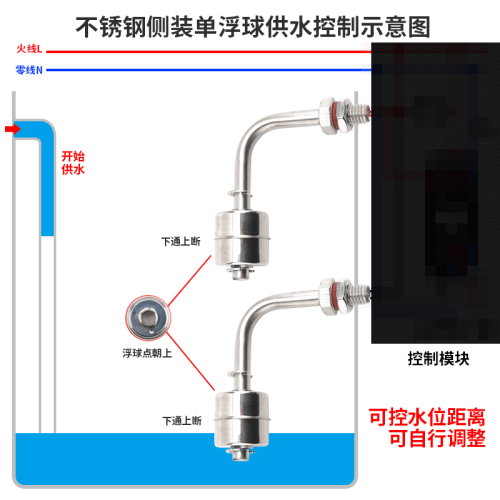
These illustrations show control arrangements. Use the actual receiving module’s connection instructions and the selected switch ratings for the installation.
Provide unrestricted float travel, keep the assembly away from external magnetic fields and protect it from impact or compression. Check the contact action after installation and inspect periodically for deposits or mechanical obstruction. Disconnect power before cleaning or servicing the assembly.
