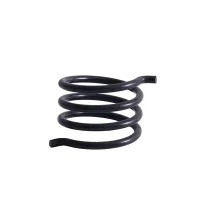


Torsion springs store energy as their arms move through an angle and apply a counteracting torque. When the external force decreases, the spring drives the mechanism back toward its initial position. This makes torsion springs useful where an assembly needs rotational reset, holding force or balance.
A helical torsion spring is commonly mounted around a central shaft, with its arms transferring the torque to adjoining components. Depending on the design, the unloaded coils may be closed or spaced. Straight, hinged and short bent arms provide different ways to engage the mechanism.
Applications range from clothespins, mousetraps and door hinges to automotive seat return mechanisms and garage door balance systems. Electrical switches, industrial hinges, clutches, brakes, toys and fitness equipment also use torsion springs. Custom sizing allows the coil form and arms to be specified around the available mounting space and required motion.
| Item | Specification |
|---|---|
| Size | Custom made. |
| Material options | Spring steel (SWC), piano wire (SWP), stainless steel (SUS), mild steel, phosphor bronze, 60Si2Mn, 55CrSi, T9A, A3, titanium alloy, nickel-plated wire, galvanized wire, tinned wire and enameled wire. |
| Surface treatment options | Galvanizing, nickel plating, anodizing, black oxidation, electrophoresis, powder coating, gold plating, silver plating, tin plating, paint, chrome plating, phosphating, Dacromet, oiling, copper plating, sandblasting, passivation and polishing. |
| Packaging | PE bags, cartons and pallets; packaging can be specified to customer requirements. |
| Application areas | Automotive hardware accessories, electrical equipment, electronic products, medical equipment, fitness equipment parts, industrial equipment, mechanical parts, office equipment and children's toys. |
| Spring and stamping manufacturing experience | 31 years. |
