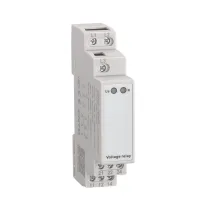


| Part Number: | CDV6 | - | 5D | 08 | P |
|---|---|---|---|---|---|
| Explanation: |
Product Family CDV6 - Voltage monitoring relay |
Dual-Output Monitoring Function 3D - Phase sequence and phase loss |
Output Contact Rating 08 - 8A version with two changeovers; also written as 8 in the ten short-form model listings |
Voltage System P - Three-phase three-wire, phase-to-phase; 220/230/240/380/400/415/440/460VAC nominal selections |
CDV6 dual-output relays monitor three-phase supplies and provide two 8A changeover contacts for equipment control and fault alarm circuits. P versions monitor phase-to-phase voltage in three-wire systems; N versions monitor phase-to-neutral voltage in four-wire systems. The six monitoring functions differ in voltage thresholds, imbalance settings and delay adjustment.
| Function code | Overvoltage | Undervoltage | Imbalance | Action delay | Phase sequence / phase loss |
|---|---|---|---|---|---|
| 3D | — | — | — | No adjustable delay specified | Both |
| 4D | Adjustable 2–20% above nominal | Adjustable 2–20% below nominal | — | Adjustable 0.1–10s | Both |
| 5D | Adjustable 2–20% above nominal | Adjustable 2–20% below nominal | Fixed 8% | Adjustable 0.1–10s | Both |
| 6D | Adjustable 2–20% above nominal | Adjustable 2–20% below nominal | Adjustable 5–15% | Fixed 2s | Both |
| 7D | — | — | Adjustable 5–15% | Adjustable 0.1–10s | Both |
| 8D | Fixed 15% above nominal | Fixed 15% below nominal | Fixed 8% | Fixed 2s | Both |
Voltage thresholds are deviations from the selected nominal voltage. Apply the fixed or adjustable settings for the chosen function. Measurement uses true RMS over 45–65Hz, with harmonic-resistant design for electrically disturbed installations.
| Complete model | Short contact-code form | Function | System | Output rating |
|---|---|---|---|---|
| CDV6-3D08P | CDV6-3D8P | 3D | P: three-wire | Two changeovers; Ith 8A; AC-15 Ie 1.5A at 250VAC |
| CDV6-4D08P | CDV6-4D8P | 4D | ||
| CDV6-5D08P | CDV6-5D8P | 5D | ||
| CDV6-6D08P | CDV6-6D8P | 6D | ||
| CDV6-7D08P | CDV6-7D8P | 7D | ||
| CDV6-8D08P | — | 8D | ||
| CDV6-3D08N | CDV6-3D8N | 3D | N: four-wire | |
| CDV6-4D08N | CDV6-4D8N | 4D | ||
| CDV6-5D08N | CDV6-5D8N | 5D | ||
| CDV6-6D08N | CDV6-6D8N | 6D | ||
| CDV6-7D08N | CDV6-7D8N | 7D | ||
| CDV6-8D08N | — | 8D |
The 8A contact segment appears as 08 in the full ordering layout and as 8 in the ten short-form models shown. Retain the full designation on the ordered relay; the leading zero does not indicate a different contact rating.
| Parameter | P | N |
|---|---|---|
| Monitoring system | Three-phase three-wire, line-to-line | Three-phase four-wire, line-to-neutral |
| Monitoring terminals | L1, L2, L3 | L1, L2, L3, N |
| Operating power | L1–L2 | L1–N |
| Nominal voltage choices | 220 / 230 / 240 / 380 / 400 / 415 / 440 / 460VAC, phase-to-phase | 127 / 132 / 138 / 220 / 230 / 240 / 254 / 265VAC, phase-to-neutral |
| Measurement range | 176–552V | 101–318V |

| Position | Code | Meaning |
|---|---|---|
| 1: Product family | CDV6 | Voltage monitoring relay |
| 2: Monitoring function | 3D / 4D / 5D / 6D / 7D / 8D | Dual-output monitoring combinations in the function table |
| 3: Output contact | 08 | 8A contact version; two changeovers |
| 4: Voltage system | P | Phase-to-phase, three-wire |
| N | Phase-to-neutral, four-wire |
| Parameter | Rating |
|---|---|
| Measured supply | Own operating voltage; true RMS |
| Frequency / measurement error | 45–65Hz / ≤1% |
| Voltage hysteresis | Fixed 2% |
| Setting method / accuracy | Knob / 10% |
| Power-on delay / reset time | 0.5s / 1s |
| Temperature fluctuation error | 0.05%/°C, referenced to 20°C |
| Output contacts | Two changeovers; 2×8A contact ratings at 250VAC/24VDC |
| AC-15 operational rating | Ie 1.5A at 250VAC |
| Minimum switching power | 500mW |
| Indicators | Green supply LED; red relay output LED |
| Mechanical / resistive electrical life | 1×10⁷ / 1×10⁵ operations |
| Operating temperature | −20 to +55°C |
| Storage and transport temperature | −35 to +75°C |
| Mounting | 35mm DIN rail; any orientation |
| Protection / installation altitude / pollution degree | IP20 / ≤2000m / 2 |
| Conductors / tightening torque | 1×2.5mm² or 2×1.5mm² / 0.8N·m |
| Overall dimensions / weight | 90×18×65mm / 67g |
Compliance references are CCC: GB/T14048.5 and CE: EN60947-5-1; applicable documentation is available for the ordered model. The output contact's 24VDC rating does not change the AC monitoring supply requirements.


The two output sets are 11/12/14 and 21/22/24. Use one for the contactor control circuit and the other for fault indication as illustrated. Connect neutral for an N version. The timing charts show the corresponding response of both changeovers.
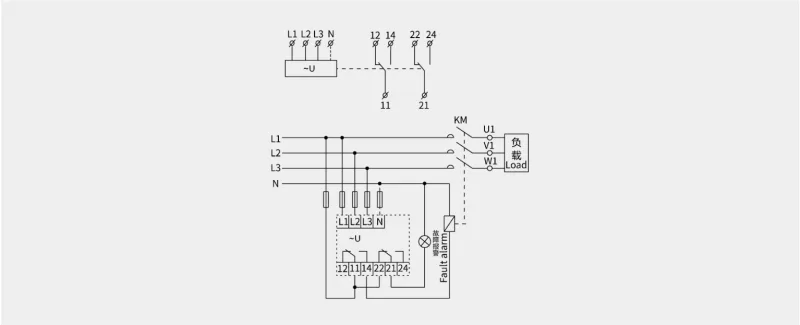

Use the appropriate monitoring function for tower cranes, air conditioners, elevators, agricultural equipment, refrigerated trucks, reverse-operation prevention, normal/emergency supply switching control and phase-loss monitoring of power loads.
These industrial relays are not intended for exceptionally high-reliability nuclear, gas or power systems; personal or property safety functions; harsh outdoor, contaminated, electromagnetic, vibration or shock environments; fire or explosion hazards; or military and aerospace applications unless specifically designed for that use and confirmed in writing.
